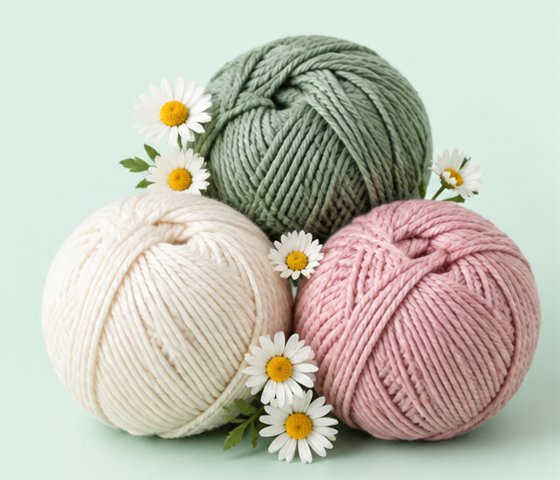
How Much Yarn Do I Need? Yardage Estimates for Blankets, Hats, Scarves and More
Realistic yarn estimates for the most common crochet projects by yarn weight, plus the swatch-and-scale method that gives you an exact number for any pattern.

Running out of yarn ten rows from the end, with the dye lot discontinued, is a rite of passage nobody wants. The good news is that yarn estimation is not guesswork. There are reliable ballpark numbers for common projects, and there is a five-minute method that gives you an exact figure for any project you can swatch.
All estimates below are for crochet, which uses about a third more yarn than knitting for the same size.
Ballpark Yardage by Project and Yarn Weight
Figures are in meters, then yards in brackets. They assume a standard stitch such as double crochet or half double crochet; add 20 to 30 percent for single crochet or textured stitches.
- Adult beanie — Fingering (1): 250 (275); DK (3): 180 (200); Worsted (4): 150 (165); Bulky (5): 110 (120)
- Scarf, 20 x 180 cm — Fingering (1): 550 (600); DK (3): 400 (440); Worsted (4): 320 (350); Bulky (5): 250 (275)
- Cowl — Fingering (1): 300 (330); DK (3): 220 (240); Worsted (4): 180 (200); Bulky (5): 140 (150)
- Baby blanket, 90 x 90 cm — Fingering (1): 1300 (1400); DK (3): 950 (1050); Worsted (4): 750 (820); Bulky (5): 600 (650)
- Throw, 130 x 150 cm — Fingering (1): 3200 (3500); DK (3): 2200 (2400); Worsted (4): 1600 (1750); Bulky (5): 1250 (1350)
- Queen bed blanket — Fingering (1): 6500 (7100); DK (3): 4500 (4900); Worsted (4): 3300 (3600); Bulky (5): 2600 (2850)
- Adult sweater, size M — Fingering (1): 1800 (2000); DK (3): 1300 (1400); Worsted (4): 1000 (1100); Bulky (5): 800 (875)
- Market bag — DK (3): 350 (380); Worsted (4): 280 (300)
- Dishcloth — Worsted (4): 60 (65)
- Small amigurumi, 15 cm — DK (3): 60 (65); Worsted (4): 50 (55)
- Pair of adult socks — Fingering (1): 400 (440)
To convert to balls, divide by the meterage on your yarn label. A 100 g ball of worsted acrylic is usually 180 to 220 m, so a throw at 1,600 m needs 8 or 9 balls. Then buy one more.
What Changes the Number
Stitch choice. Single crochet is dense and eats yarn. Double crochet is open and economical. Rough multipliers relative to double crochet:
- Single crochet: 1.3x
- Half double crochet: 1.15x
- Double crochet: 1.0x
- Treble: 0.9x
- Bobbles, puffs, popcorns: 1.4x to 1.6x
- Granny squares: about 1.1x, plus extra for joining and border
Your tension. Loose crocheters use more yarn per stitch. If your gauge comes out larger than the pattern's, you will need more.
Hook size. A bigger hook makes a looser fabric that uses less yarn per square centimeter but needs more area to reach size. It roughly cancels out.
Borders. A simple sc border on a throw uses 80 to 150 m. A wide decorative border can take a full ball.
Color changes. Every join costs a few centimeters of tail, and stripes with many changes can add 5 to 10 percent.
The Swatch-and-Scale Method
This gives you an actual number instead of a ballpark.
- Make a swatch in the exact yarn, hook and stitch of the project. Around 15 by 15 cm is enough.
- Weigh the swatch on a kitchen scale in grams. Suppose it weighs 12 g.
- Measure its area. 15 x 15 = 225 cm².
- Divide to get grams per cm²: 12 / 225 = 0.053 g/cm².
- Calculate the finished project's area. A throw of 130 x 150 cm = 19,500 cm².
- Multiply: 19,500 x 0.053 = 1,034 g.
- Add 10 percent for border, joining and safety: about 1,140 g. That is 12 balls of 100 g.
If the label gives meterage per gram, you can convert to meters, but grams are what you buy, so grams are what you need.
The Mid-Project Check
Once you are a few rows in, you can predict the total accurately:
- Weigh the work so far. Say it is 60 g after 8 rows.
- Grams per row: 60 / 8 = 7.5 g.
- Rows remaining: if the pattern needs 70 rows, 62 remain.
- Yarn remaining needed: 62 x 7.5 = 465 g.
- Compare with the unused yarn you have. If you are short, buy now while the dye lot is still on the shelf.
Amigurumi and Small Items
These are hard to estimate by area because they are three-dimensional. Use the weight method: crochet the largest piece (usually the body), weigh it, and estimate the rest proportionally. Most amigurumi under 20 cm tall use well under one 50 g ball of the main color, and a scrap for each accent color.
Buying Rules That Save Trouble
- One extra ball, always. Leftovers become granny squares, coasters or amigurumi.
- Same dye lot for solid colors. For hand-dyed or variegated yarn, alternate skeins every two rows from the start so no shift ever shows.
- Check the return policy. Many yarn shops accept unused balls back within a month or two.
- Photograph the label. Dye lot, color number, brand. When you run out in six months, you will thank yourself.
When Precision Does Not Matter
For a scarf, a cowl, or a scrap blanket, you do not need any of this. Crochet until the yarn runs out and call that the length. The tables are for the projects where the size is fixed and the yarn is not: blankets that must cover a bed, sweaters that must fit, and gifts with a deadline.
Frequently asked questions
How many balls of yarn do I need for a blanket?
A throw-size blanket, roughly 130 by 150 cm, takes about 1,400 to 1,800 meters of worsted yarn, which is 7 to 10 balls of 100 g, depending on the stitch. Double crochet uses less than single crochet, and textured stitches like bobbles use noticeably more.
How much yarn for an adult beanie?
About 120 to 180 meters of worsted yarn, so one 100 g ball is enough with some left over. Bulky yarn beanies use around 80 to 120 meters.
Does crochet use more yarn than knitting?
Yes, roughly 25 to 30 percent more for the same fabric size. If you are converting a knitting yardage estimate, add a third.
What if I run out of yarn mid-project?
Buy the same yarn and, if possible, the same dye lot. If the dye lot is different, alternate rows between the old and new ball for a few rows so the transition is invisible.
Keep reading
More in Yarn Guides →-
Cotton vs Acrylic vs Wool Yarn: Which One for Which Crochet Project?
The three yarn fibers you will use most, compared on warmth, drape, washability, cost and stitch definition, with a project-by-project recommendation.
-
Best Yarn for Beginners: What to Buy for Your First Crochet Projects
The yarn you learn with decides how frustrating your first week is. Here is what to buy, what to avoid, and why a light-colored worsted acrylic or cotton is the right first ball.
-
Yarn Weights Explained: The Complete Chart From Lace to Jumbo
The 0 to 7 yarn weight system explained in plain English, with a chart of recommended hook sizes, gauge, common names by country, and which weight to pick for each kind of project.