How to Crochet for Beginners: A Complete Step-by-Step Guide
Learn how to crochet from absolute zero: choosing yarn and hooks, holding the hook, the chain stitch, single crochet, and your first easy project.

Crochet looks complicated from the outside — hundreds of identical little knots forming a blanket — but it's built from just a handful of movements repeated over and over. This guide takes you from never having held a hook to finishing your first rows, in the same order a patient teacher would.
What You Need to Start
You only need two things, and together they cost less than a takeaway coffee:
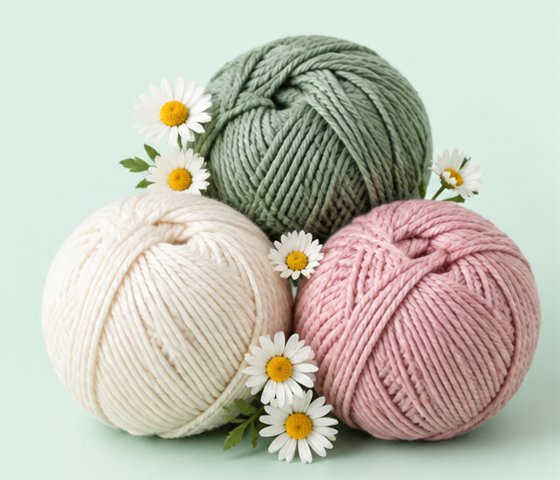
Yarn: Choose a worsted weight yarn (also labeled "medium" or "#4") in a light, solid color. Light colors make it much easier to see your stitches. Cotton or acrylic both work; acrylic is cheaper and more forgiving.
Hook: A 5.0 mm or 5.5 mm hook (US size H-8 or I-9). Aluminum hooks glide well; ergonomic hooks with rubber handles are kinder to your hands during long sessions.
Skip the kits with 50 accessories for now. A hook, a ball of yarn, and a pair of scissors are genuinely all you need.
Holding the Hook and Yarn
There are two common grips:
- Pencil grip: hold the hook like a pencil, resting on your middle finger.
- Knife grip: hold it overhand, like cutting vegetables.
Neither is "correct." Try both for a few minutes and keep whichever feels natural. With your other hand, drape the yarn over your index finger so you can control its tension. Your tension will be uneven at first — that is normal and it fixes itself with practice.
Step 1: The Slip Knot
Every crochet project starts with a slip knot:
- Make a loop with the yarn, tail hanging behind.
- Reach through the loop, grab the working yarn, and pull it through.
- Slide the new loop onto your hook and tug gently until it hugs the hook — snug, but loose enough to slide.
Step 2: The Chain Stitch (ch)
The chain is the foundation of almost everything in crochet.
- Wrap the yarn over the hook from back to front (this is called a yarn over).
- Pull that yarn through the loop already on your hook.
That's one chain. Repeat until you have 20 or so. They should look like a row of little V shapes. If your chains are so tight you can't get the hook back in, consciously loosen up — beginners almost always chain too tightly.
Practice this until you can make an even chain of 20 without thinking. Seriously — undo it and redo it five times. This single motion trains 80% of the coordination crochet needs.
Step 3: Single Crochet (sc)
Now you'll build fabric on top of your chain:
- Make a foundation chain of 15.
- Insert your hook into the second chain from the hook (the loop counts, the one on your hook doesn't).
- Yarn over, pull up a loop — you now have 2 loops on the hook.
- Yarn over again, pull through both loops.
That's one single crochet. Work one into every chain across. At the end of the row, chain 1 (the turning chain), turn your work like a page of a book, and single crochet into each stitch of the row below.
Keep going until you have a small square. Congratulations — that's real crochet fabric.
Counting Stitches (the Habit That Saves Projects)
The #1 beginner problem is rows that mysteriously shrink or grow. The cause is almost always a missed stitch at the end of a row or an accidental extra one at the start. Count your stitches after every row for your first few projects. If you started with 14, every row should have 14.
Your First Real Project
Once your squares look even-ish, make a dishcloth: chain 26 with cotton yarn, single crochet every row until it's square, cut the yarn, and pull the tail through the last loop. It's useful, fast, and nobody inspects a dishcloth for mistakes.
From there, the natural next steps are the half double crochet, the double crochet, and the legendary granny square — at that point, most patterns on the internet are open to you.
Quick Troubleshooting
- Edges getting wider: you're adding a stitch in the turning chain. Skip it.
- Edges shrinking: you're missing the last stitch of the row. Count.
- Fabric stiff as cardboard: your tension is too tight, or your hook is too small for the yarn. Go up a hook size.
- Yarn splitting: slow down, and angle the hook tip slightly downward when inserting.
Ten minutes a day beats two hours once a week. Your hands learn crochet the way they learned handwriting — through boring, glorious repetition.
Keep reading
More in Free Patterns →-
Double Crochet Stitch (dc): The Complete Beginner Tutorial
Learn the double crochet stitch step by step, including the turning chain rule, how to keep your edges straight, and why this is the fastest stitch for blankets.
-
Single Crochet Stitch (sc): How to Do It, Count It, and Fix It
A clear single crochet tutorial: the stitch step by step, how to turn rows without losing stitches, counting tips, and fixes for the mistakes every beginner makes.
-
Crochet vs Knitting: Which Should You Learn First?
Crochet or knitting — which is easier, faster, and better for beginners? An honest comparison of tools, learning curve, speed, fabric, and what each craft is best at.